Facebook Pixel .
Close
About us
Find out more
Our portfolio
Find out more
Sustainability
Sustainability Strategy
Discover our Sustainability Strategy
Sustainable Mining Plan
FutureSmart Mining™
Find out more
Investors
Find out more
Careers
Find out more
Media
Find out more
Suppliers
Find out more
Origins
Main Content

Our approach to reducing our Scope 3 emissions

While Scope 3 emissions are always the direct emissions of another entity, Anglo American recognises the role we can play in helping to reduce the emissions intensity of our value chain and therefore reducing our Scope 3 emissions.

We are focused on collaborating with our highest-emitting customers and suppliers to work towards a common goal of emissions reduction through efficiency savings and technological advancements.

A critical part of our strategy to reduce our Scope 3 emissions is to help accelerate the decarbonisation of the steel industry through us prioritising the production and sale of premium iron ore, a key component in lower-carbon steelmaking.

Steel remains critical to development and industrialisation, as well as forming the foundation for low-carbon infrastructure. Our premium iron ore operations provide high iron ore content products, with a weighted average Fe content exceeding 65% in products sold during 2024, helping steel producers to minimise emissions while boosting productivity.

Through our customer strategy and focus on product quality, we continue to make progress in reducing the emissions intensity of our iron ore in steelmaking as we focus on sales to lower-emissions steelmakers and steelmaking processes.

Carbon intensity target from the use of our premium iron ore products
1.3t CO2e
per tonne of crude steel made from our premium iron ore products by 2040.

The processing and use of our iron ore by our customers is by far the largest contributor to our Scope 3 emissions, accounting for around 85% of total 2025 Scope 3 emissions. As a consequence, this is the focus for us in addressing our Scope 3 emissions.

The target we have set is that by 2040 the average emissions intensity of steel made with our iron ore will be no more than 1.3 t CO2e per tonne of crude steel (t CO2e/tCS). This is on a ‘cradle to crude’ basis, including the upstream Scope 3 emissions of steelmakers, but excluding any impact from scrap.

This target is aligned with the IEA’s production assumptions under a 1.5°C aligned pathway that steelmaking emissions intensity must fall to below 1.34 t CO2e/tCS by 2040. We believe, therefore, that our target is aligned with the objectives of the Paris Agreement.

We remain committed to reducing Scope 3 emissions associated with upstream procurement and our oceanic freight.

To manage upstream emissions in our supply chain, we have a clear action plan. This includes engaging with our largest-emitting suppliers to foster collaboration, improve data quality, and better understand their decarbonisation targets and progress. We will also build awareness of decarbonisation and climate change across our broader supplier base.

In regards to emissions associated with the shipping of our product, in 2024 we achieved a significant milestone with the successful delivery of the Ubuntu Liberty, the final vessel in our 10-strong chartered fleet of Capesize+ Liquefied Natural Gas (LNG) dual-fuelled bulk carriers.

The LNG dualfuelled technology and enhanced fuel efficiency of the Ubuntu fleet provides our customers the opportunity to reduce their carbon emissions when using these vessels, which are expected to deliver up to a 35% reduction in CO2 emissions compared with conventionally fuelled ships. The increased cargo capacity of the Ubuntu vessels has also provided operational efficiencies

Looking forward, we will continue to assess the feasibility of existing and emerging technologies, their commercial efficacies, and time these solutions to market. We have established partnerships to test technologies in wind and in alternative-fuelled realities. In parallel, we will explore efficient solutions in conventional technologies.
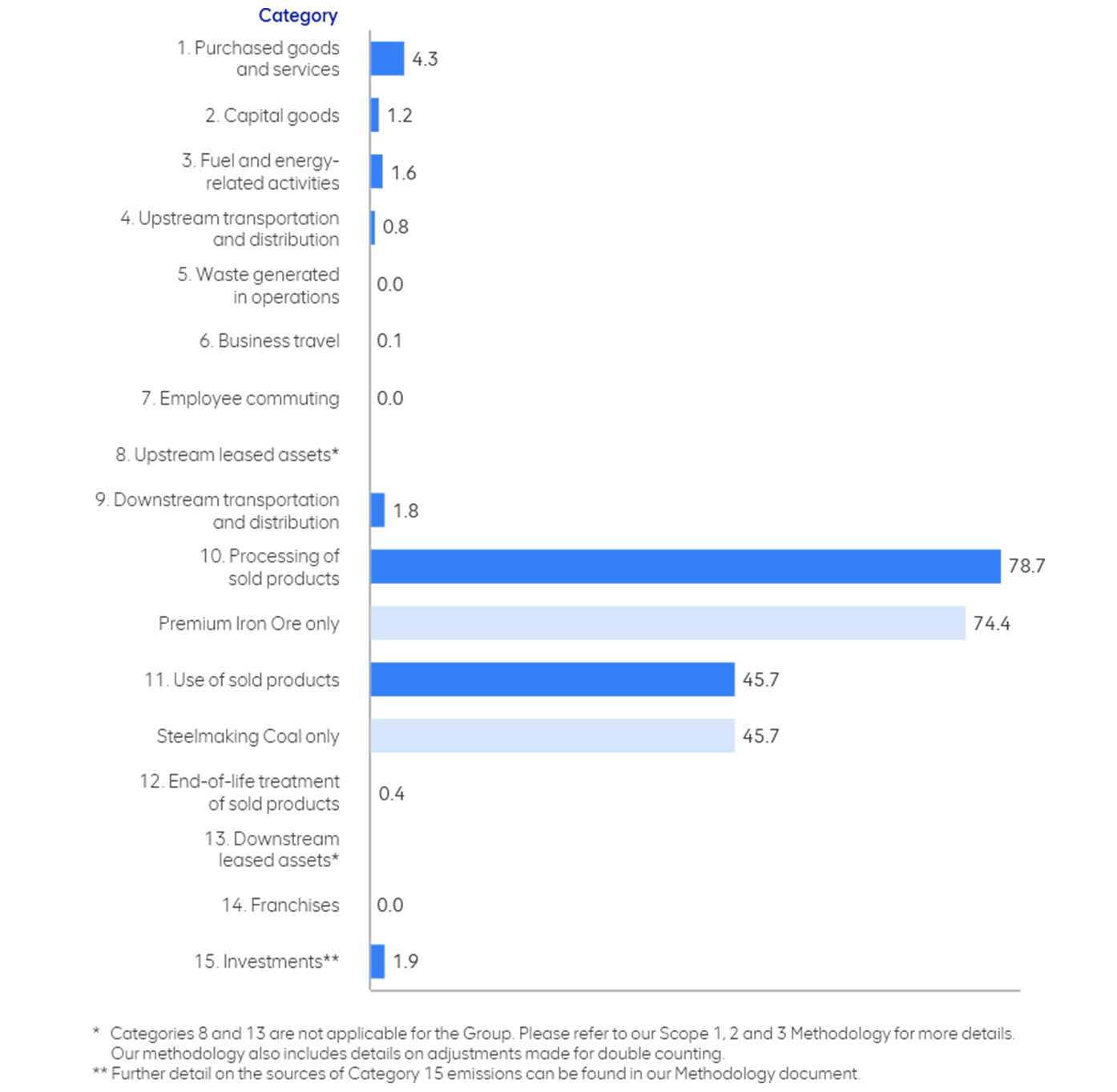
 

Decarbonising our value chain

Click on image for enlarged version

Decarbonising our value chain

Find out more related to decarbonising our value chain

plc