Facebook Pixel .
Close
About us
Find out more
Our portfolio
Find out more
Sustainability
Sustainability Strategy
Discover our Sustainability Strategy
Sustainable Mining Plan
FutureSmart Mining™
Find out more
Investors
Find out more
Careers
Find out more
Media
Find out more
Suppliers
Find out more
Origins
Main Content

Introduction

The Water focus area within the Healthy Environment theme is how we protect, preserve and restore our water catchments to support resilient operations, communities and the environment.

Water is a key priority for a wide variety of stakeholders, and a critical enabler of our operational performance, as well as long-term growth. It is recognised by the UN as a fundamental human right and closely linked to our wider sustainability agenda - including nature, climate resilience and community wellbeing.

Our updated approach introduces business-specific targets, enabling us to address both water-scarce and non-water scarce areas and focus on local water priorities.

This is in line with international best practice, which is to set targets and take actions that are meaningful to all stakeholders and create holistic value, as well as improving operational resilience. It also helps us better track outcomes like collaboration, trust-building, and governance improvements, which are often hard to measure.

Water stewardship is an on-going journey.  As our understanding evolves, we are committed to enhancing transparency, strengthen partnerships and support initiatives that build catchment resilience.

Our approach

We take a responsible water stewardship approach, that focuses on operational performance, local catchment health and long-term resilience.

These targets are designed to create value across multiple dimensions, including biodiversity and ecosystem services, community and social license, climate adaption and operational resilience.

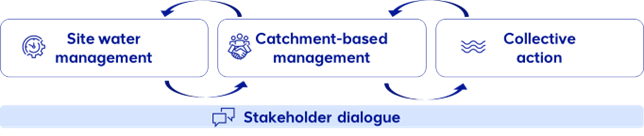
Our approach includes:


  • Site water management: ensuring water security, improving water efficiency, and managing both use and excess water.
  • Catchment-based management: considering the broader catchments where we operate; addressing water accessibility, availability and resilience for our operations, communities and local ecosystems.
  • Collective action: working with stakeholders to strengthen governance and enable shared, sustainable water solutions.

Ambition & targets

Ambition

Protect, preserve and restore our water catchments to support resilient operations, communities and the environment.

Target

Business-specific targets focus on local water priorities, align with asset strategies, and include time-based milestones to track progress. Business-specific targets include:

  • Brazil: Support the protection of watersheds through forest restoration, local government initiatives, and improved operational systems to use water efficiently.
  • Chile: Achieve zero fresh water use at Los Bronces in the mining process by 2030 and strengthen community resilience to climate-related water risks.
  • Kumba Iron Ore: Support equitable water access and ecosystem resilience through surplus water management and groundwater recharge.
  • Peru: Contribute to resilient water stewardship by supporting measures to improve water security, risk management and inclusive access.

SEO Purpose H2 tag hidden

Brazil Icon Plus

Context

Situated in the upper Doce River Basin, a region with highly variable rainfall and significant pressures from erosion, sedimentation, and deforestation. Minas-Rio faces additional challenges from periodic droughts, intense rainfall events, and water quality deterioration driven by untreated sewage, industrial effluent and agrochemical runoff.

Target

Support the protection of watersheds through forest restoration, local government initiatives, and improved operational systems to use water efficiently.

Sub-targets and milestones

  • Contribute to watershed resilience through forest restoration.
    • 2026: Establish an integrated forest-water management plan aligning with local biodiversity objectives.
    • 2030: Restore priority degraded areas identified, focusing on riparian zones.
  • Support local government in ensuring access to Water, Sanitation and Hygiene (WASH).
    • 2027: Deliver studies and finalise technical recommendations for WASH planning.
    • 2030: Facilitate implementation support for priority WASH upgrades*.
  • Enhance operational resilience through implementation of a tailings filtration plant.
    • 2026 - 2028: Complete full ramp up of tailings filtration plant.
    • 2027 - 2028: Measure incremental water availability through filtration to improve water efficiency and integrate findings into water balance planning

Subject to external Government approval to advance the technical recommendations identified through the completed studies.

Chile Icon Plus

Context

Operations are located in central Chile within the Maipo and Aconcagua basins, regions under severe water stress, with increasing pressure on fresh water sources due to a decade long drought, climate change-driven snowpack decline, and competing demands from agriculture, urban growth, and mining.

Target

Achieve zero fresh water use at Los Bronces in the mining process by 2030 and strengthen community resilience to climate-related water risks.

Sub-targets and milestones

  • Achieve zero fresh water consumption for mining processes at Los Bronces by 2030.
    • 2026: Commission desalinated seawater supply for the Los Bronces operation and make available 25 l/s  to communities surrounding Las Tórtolas.
  • Enhance the adaptive capacity of communities to manage climate-related water security risks through collaborative initiatives as part of our community water access strategy.
    • 2026: Finalise approved framework and approach for ensuring long term viability of the Rural Water Model* in prioritised zones.
    • 2027: Implement the first SIGTH (Integrated territorial water management system)** pilot including strengthening government technical capacity.
    • 2027: Embed the agreed long‑term solution for the Rural Water Model and SIGTH pilot approach into the water access strategy.

The Rural Water Model is an initiative to strengthen capacity within communities and water rural organisations in the area of influence of our operations.

**  The SIGTH integrates water data to support water management.

Kumba Iron Ore Icon Plus

Context

Sishen and Kolomela are in semi-arid catchments with low rainfall, high evaporation, and heavy reliance on groundwater for all users including mining, municipal, and agriculture. The hydrological system is fragile, with limited recharge, growing demand, and climate variability.

Target

Support equitable water access and ecosystem resilience through surplus water management and groundwater recharge.

Sub-targets and milestones

  • Mitigation of shared catchment challenges*, including supporting equitable water access.
    • 2026 - 2030: Continue diversion of surplus/ excess water volumes into the regional Water Supply Scheme.
    • 2026 – 2030: Continue withdrawals of treated sewage effluent from the Gamagara Municipality wastewater treatment works for plant operations and processes.
  • Replenishing of groundwater table through artificial aquifer recharge.
    • 2026 - 2030: Delivery of aquifer recharge programmes in the catchments in which we operate.

Shared water challenges are inclusive of water scarcity or seasonal variability, pollution and declining water quality, ecosystem degradation, flooding or drought risks, governance gaps.

Peru Icon Plus

Context

Operations are located within the Moquegua and Tambo watersheds, regions facing water stress due to limited natural infrastructure, climate variability, and competing demands from agriculture, communities, and mining.

Target

Contribute to resilient water stewardship by supporting measures to improve water security, risk management and inclusive access.

Sub-targets and milestones

  • Support effective management of water-related risks and opportunities within the watershed where Quellaveco operates.
    • 2026: Deliver the regional water balance study.
    • 2028: Finalise an integrated water security and risk management strategy at the watershed level.
  • Promote equitable and sustainable water access in the Moquegua-Ilo watershed through the implementation of sanitation and irrigation infrastructure and strengthening technical capacities of local operators.
    • 2026 – 2027: Complete the implementation of scheduled sanitation and agricultural infrastructure projects
    • 2028 – 2030: Update and implement the portfolio of additional sanitation and irrigation infrastructure projects.
    • 2026: Deliver a comprehensive assessment of the operational capacity of local operators.
    • 2027 – 2030: Deliver a capacity-building programme for prioritised local operators.

Navigate our Sustainability Strategy

Use this model to learn about the themes and focus areas within our Sustainability Strategy.

Sustainability stories

Sakatti: Pioneering sustainable mining in Finland

Water stewardship

Learn more
Copper: Connecting the world

Kolomela Innovative Water Solution

Click to watch
World Water Week

World Water Week

Learn more
plc