The geology of orebodies is inherently variable, and the ability to characterise that variability accurately and in time to inform operational decisions is critical to effective mine planning and processing performance. Conventional ore characterisation methods (including drilling, geological modelling and laboratory sampling) provide essential information, but can often involve delays between data collection, analysis and operational response. This may limit the precision of ore selection in the pit and impact the quality of material sent to the plant for processing.
In response to this challenge, Anglo American is developing sensing technologies that are bringing real-time ore intelligence into operations, enabling teams to make faster, better-informed decisions as material moves through the process.
The goal is to shift ore control from reactive to predictive. Instead of relying only on delayed laboratory analysis, sensing technologies can continuously assess ore characteristics directly in-pit, on conveyors, or within processing streams. To explore this opportunity, we have been studying systems to improve ore routing, reduce dilution, stabilise plant feed and ultimately, recover more value from the orebody.
Testing sensing technologies in the real world
At our Minas-Rio iron ore operation in Brazil, the presence of alumina-rich clay in the orebody was identified as a source of variability that could be more effectively and proactively managed to optimise operational performance, with a technoeconomic study indicating a significant value opportunity for sensing and selective mining. Initial test work was carried out at Anglo American’s Sensor Fusion Loop in South Africa – a full-scale testing facility designed specifically to evaluate sensing technologies in real-world operating conditions.
Ore from Minas-Rio was tested using multiple sensing approaches under both wet and dry conditions to determine whether problematic high-alumina material could be accurately identified.
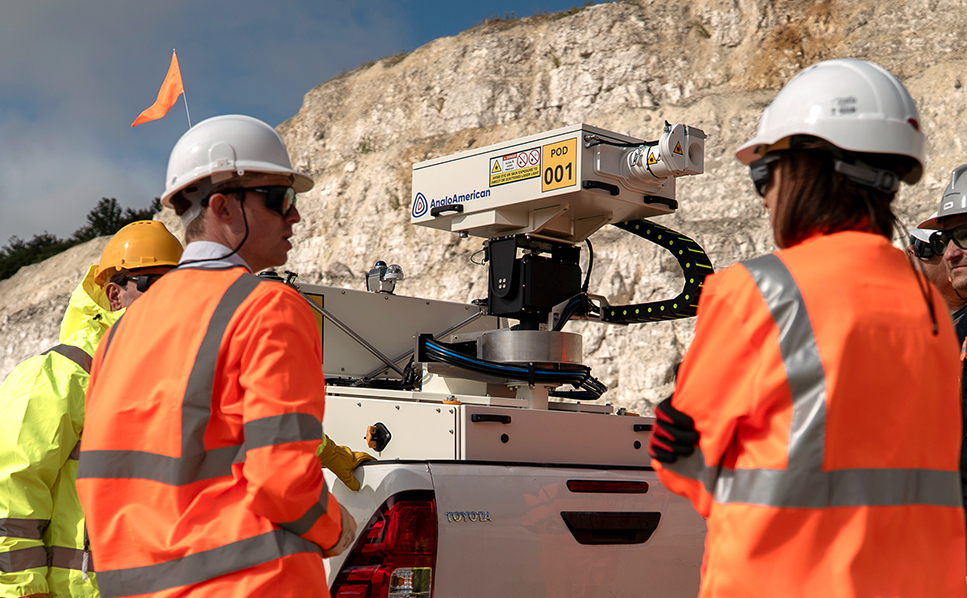
Initial results demonstrated the effectiveness of Active Hyperspectral Sensing (AHS) – a new technology developed in partnership with Finnish researchers at VTT. Unlike conventional hyperspectral systems, which often underperform in mining environments, due to changing light conditions and operational complexity, AHS uses an actively controlled light source that enables more reliable sensing directly in the field.
During testing, results indicated that the new technology achieved a high degree of accuracy in differentiating key ore types from Minas-Rio, representing an important milestone in demonstrating the feasibility of real-time ore classification in operational mining environments.
The next challenge was determining whether the technology could work in-pit, under typical operating conditions.