Facebook Pixel .
Close
About us
Find out more
Our portfolio
Find out more
Sustainability
Sustainability Strategy
Discover our Sustainability Strategy
Sustainable Mining Plan
FutureSmart Mining™
Find out more
Investors
Find out more
Careers
Find out more
Media
Find out more
Suppliers
Find out more
Origins
Main Content

As part of our FutureSmart Mining approach to innovation and sustainability, we have developed four aspirational concepts that we are working to achieve. In this article, we take a look at the Water-less Mine and its future impact on water use in mining…

Mining has always been heavily dependent on water.

Without water, the extraction of copper, platinum group metals, diamonds and other valuable products would be practically impossible. But water is becoming increasingly scarce: with a predicted shortfall of 40% by 2030, the shortage of clean fresh water represents the greatest global societal and economic risk over the next decade [source: World Economic Forum]. And with approximately three quarters of our operations across the world in water-stressed areas, the impact of mining on water and water conservation is a critical concern.

Our ambition is, where possible, to eliminate fresh water from our mining processes, especially in the separation and transportation of ore and waste (tailings). Here’s how we’re doing it:

1. Increasing water efficiency with a closed loop recycling system

We’re already making progress towards water-less mining. We use a sealed system approach that aims to deliver greater water efficiencies through direct water recycle and reuse.

Most mines operate some sort of recycling system to minimise the draw on new water but the concept behind “closed loop” is to absolutely minimise water losses by using the same water again and again. Today, we meet two thirds of our total operational water requirements in this way.

To implement this closed loop strategy, our operations employ number of existing and new technologies.

We are focusing our innovation efforts in two areas: evaporation measurement and dry tailings (waste) disposal.

Image of the waterless mine

2. Measuring evaporation rates to conserve more water

For most mining operations, water is stored in dams to ensure a reliable water supply and to enable the recycling of water. Evaporation losses in our own dams account for 10% to 25% of total water lost at a mine. Not only are we wasting a very scarce and precious resource, this water costs approximately US$200 million annually to replace.

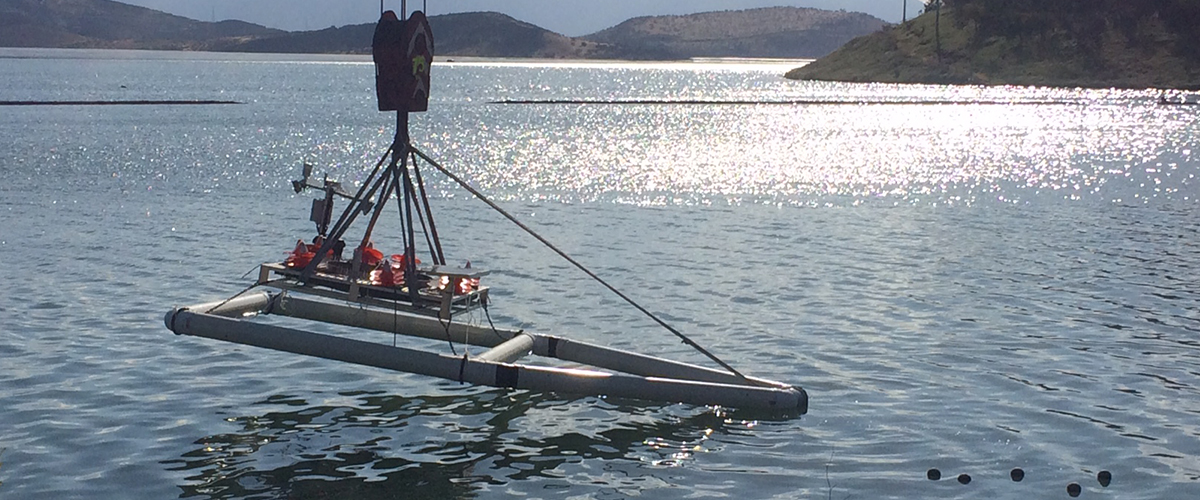
At our Dawson Mine, in Queensland Australia, we have installed a new technology developed by Australia’s Commonwealth Scientific and Industrial Research Organisation (CSIRO) that supports the more accurate measurement of evaporation rates.

Consisting of two floating buoys, the technology quickly calculates (over 3-6 months) the relationship between local meteorological conditions and actual evaporation – producing much more accurate evaporation data. Having accurate evaporation data drives a better understanding of the water balance at the mine site, focusing efficiency efforts in areas where impact can be greatest.

The potential for this technology to feed into other data-rich technologies is exciting. For example, it supports “pervasive sensing”, another innovation that uses fibre optics to measure water flows, not only to conserve water but to support process control and, ultimately, metal recovery. Our mine sites are large and complex so delivering accuracy, automation and real-time monitoring of all mine-wide water and process flows provides the type of control needed to deliver real water savings. Following a successful proof of concept we are now trialing this technology in our open-pit platinum mine in South Africa.

3. Using (Low-cost) Dry tailings disposal to limit water loss

Water sent to tailings disposal often represents the largest water loss at a mine.
Fine particle slurries in particular are difficult to dewater and current dry disposal options have prohibitive capital and operating costs. As part of our pioneering Concentrate the MineTM concept we are exploring low cost methods to minimize the amount of water sent to the tailings pond in the first place.

Our approach combines course particle flotation to concentrate the mineral, and dry stacking technologies to dewater the residual waste, producing dry, stackable tailings. Essentially, it allows us to float particles at sizes two to three times larger than normal making it easier to extract water from the process and leaving a waste stream that is dry and stackable.
But there will always be a portion of ultra-fine particles that also require processing. In partnership with major chemical companies we have done some promising lab work on copper tailings using [Soane] additives that separate interstitial water from fine metal particles – not only making them easier to recover but also resulting in dry, stackable tailings.

4. Innovating with dry separation techniques that use less water

In addition to dry processing, we are also exploring innovative methods for dry separation. Dry separation involves finding innovative methods for dry comminution (the crushing and grinding, usually sequentially, of ore to the required particle size.

More targeted comminution creates a pre-concentrate of the ore, rejecting and dewatering waste far earlier in the process. Early estimates indicate the potential for a 30-40% reduction in water used per unit of mineral production, as well as the other benefits including increased production.

Using less water when separating waste rock from ore

In parallel with our dry separation technologies, we are also laboratory testing a non-aqueous processing technique, again in partnership with a global leader in science innovation, using a bespoke polymer instead of water to separate the valuable ore from the remaining waste rock particles.

Applicable across most of our core assets, we are confident that these dry processing techniques will allow us to reuse 80% of process water, moving us closer to our goal of a waterless mine – while delivering on our sustainability goals.
Picture this: The Modern Mine

Picture this: The Concentrated Mine

Picture This: The Intelligent Mine

  • Turning used mine water into a community win
    Communities
    Turning used mine water into a community win
    15 September 2017
  • Image of science center
    Communities
    Five reasons to visit the Conceição do Mato Dentro...
    30 August 2018
  • Our blueprint for the future of sustainable mining
    Communities
    Our blueprint for the future of sustainable mining
    13 March 2018
  • Making STEM education a priority for girls
    Communities
    Making STEM education a priority for girls
    15 September 2017
  • Image of cheese production
    Communities
    A day in the life of Nicinha: a local cheese...
    8 August 2017
  • Image of biodiversity leadership at minas rio
    Environment
    Biodiversity leadership at Minas-Rio – conserving...
  • Mining solutions
    Environment
    Mapping the Mine to Sustainable Development Goals
    24 September 2019
  • Image representing solar energy
    Environment
    4 Ways the Mining Industry Uses Renewable Energy
    24 September 2019
  • Three ways biodiversity awareness is critical to mining
    Environment
    Three ways biodiversity awareness is critical to...
    10 September 2019
  • biodiversity strategy image
    Environment
    Behind every successful mining company is a strong...
    4 July 2018
  • Our blueprint for the future of sustainable mining
    Environment
    Our blueprint for the future of sustainable mining
    13 March 2018
  • Image of innovation
    Environment
    17 January 2018
  • Defining water future
    Environment
    Defining our water future
    1 December 2017
  • Positive impact to biodiversity
    Environment
    Why business needs to achieve a net positive...
    30 November 2017
  • Resilience and innovation
    Environment
    Climate change: A need for resilience and...
    29 November 2017
  • Our blueprint for the future of sustainable mining
    Corporate leadership
    Our blueprint for the future of sustainable mining
    13 March 2018
  • Image of innovation
    Corporate leadership
    A new world of geoscience data
    3 January 2018
  • Image of building platinum partnerships
    Corporate leadership
    Building platinum partnerships
    30 November 2017
  • Image of extraction sector
    Corporate leadership
    Peru’s journey: the importance of transparency in...
    1 December 2017
  • Image of transformation in south africa
    Corporate leadership
    Transformation in South Africa
    29 November 2017
  • Image of operational intelligence
    Safety and our people
    Using data analytics to build a safer workplace...
    28 September 2018
  • Image of human factor analysis
    Safety and our people
    Human Factor Analysis – an evolution in safety
    20 February 2018
  • Our blueprint for the future of sustainable mining
    Safety and our people
    Our blueprint for the future of sustainable mining
    13 March 2018
  • Image of life dineo thulo
    Safety and our people
    Meet Dineo, safety officer
  • Image of road technology
    Safety and our people
    Road technology first for Los Bronces road
    1 December 2017

Other stories you might like

plc