Facebook Pixel .
Close
About us
Find out more
Our portfolio
Find out more
Sustainability
Sustainability Strategy
Discover our Sustainability Strategy
Sustainable Mining Plan
FutureSmart Mining™
Find out more
Investors
Find out more
Careers
Find out more
Media
Find out more
Suppliers
Find out more
Origins
Main Content

Open-pit, underwater, and underground mining. These are the three main methods of mining we use to extract our products from the ground. In this Digging Deeper article, we take a look at these different methods and provide a glimpse into what each involves.

Image of mining methods

Mining is at the heart of our business at Anglo American. It is the foundation against which all of our activities rely and gravitate around. And that’s why it’s so important we conduct our types of mining activities effectively and intelligently.

Of course, before we break ground, we need to first discover mineral resources through exploration and allow a period for planning our mining techniques, ensuring all the right parts and pieces are in place and ready before we embark on mining activity.

Once all this is complete, we are ready to go.

But what are the mining methods we use to reach our diverse range of products?

1. Open-pit mining

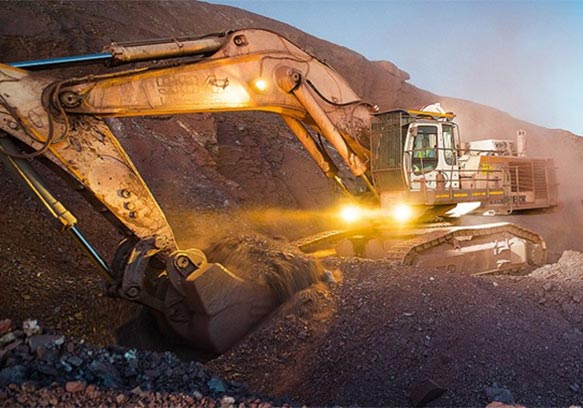
Open-pit is one of the most common mining methods used and starts from the earth's surface, maintaining exposure to the surface throughout the extraction period. The excavation usually has stepped sides to ensure the safety of the miners and a wide ramp where equipment can travel, allowing the product to be removed efficiently from the site.

Open-pit mining is practical when the ore-bodies of the rock are large and located closer to the surface.

Advantages of open-pit mining include:

  1. Powerful trucks and shovels can be used to move large volumes of rock.
  2. Equipment not restricted by the size of the opening you are working in.
  3. Faster production.
  4. Lower cost to mine means lower grades of ore are economic to mine.

The simple graphic below displays the sequence of events for the open-pit mining cycle.


How the open pit mining process works

Learn more about open-pit mining

2. Underground mining

Underground mining is used to extract ore from below the surface of the earth safely, economically and with as little waste as possible. The entry from the surface to an underground mine may be through a horizontal or vertical tunnel, known as an adit, shaft or decline.

Underground mining is practical when:

  1. The ore body is too deep to mine profitably by open pit.
  2. The grades or quality of the orebody are high enough to cover costs.
  3. Underground mining has a lower ground footprint than open pit mining.
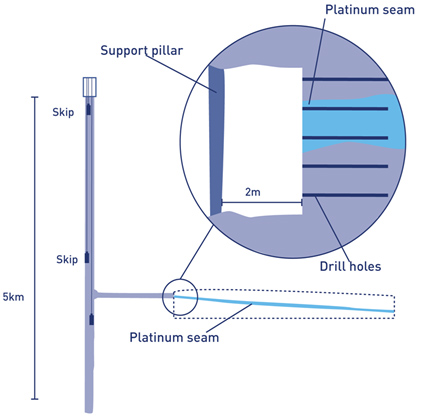
Diagram to illustrate narrow vein stoping in underground mining

What is underground mining?

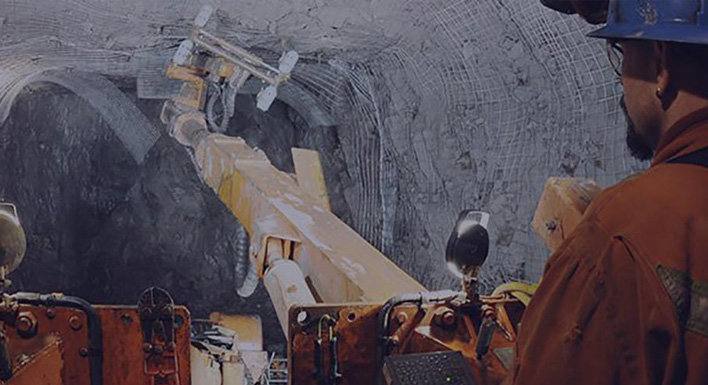
The underground mining methods we use include room and pillar, narrow vein stoping and large-scale mechanised mining.

Room and pillar mining is a style of mining where tunnels are driven in a chess board pattern with massive square pillars between them which are gradually cut away as the work proceeds. We use this for mining coal.

Narrow vein stoping is performed in an underground excavation along geological ‘veins’ — distinct sheet-like bodies of crystallized minerals within a rock – where the mineral is mined and removed. To support underground mine stoping, we also have to make excavations for engine rooms and pump chambers or for access purposes such as shafts, drives, winzes and raises. We use this for mining platinum.

Large scale mechanised mining methods we use include:

  • long-wall mining, where a long wall of coal is mined in a single slice, usually by a large machine.
  • sub-level-caving, where levels of the ore are blasted by explosives; and
  • block caving, where large areas of the ore body are blasted and then extracted with the assistance of gravity.

We use these three different types of underground mining techniques for coal, diamonds and copper.

3. Underwater mining

Underwater mining is necessary when the product you’ve identified is located within an aquatic environment like the sea floor. It’s a unique challenge – and one that requires a responsible approach that thoughtfully considers the local ecosystem.

We conduct underwater mining with purpose-designed ships using either a remotely operated underwater vehicle or drill technology at depths of 100-140 metres below sea level.

Our Debmarine Namibia fleet of vessels remain at sea for approximately two and half years and are operated from Port Nolloth, a sea port located on the northwestern coast of South Africa.

Refuelling is conducted at sea and freshwater is produced on-board. There is a crew of 60 people and they rotate 28 days on, 28 days off.


  • Turning used mine water into a community win
    Communities
    Turning used mine water into a community win
    15 September 2017
  • Image of science center
    Communities
    Five reasons to visit the Conceição do Mato Dentro...
    30 August 2018
  • Our blueprint for the future of sustainable mining
    Communities
    Our blueprint for the future of sustainable mining
    13 March 2018
  • Making STEM education a priority for girls
    Communities
    Making STEM education a priority for girls
    15 September 2017
  • Image of cheese production
    Communities
    A day in the life of Nicinha: a local cheese...
    8 August 2017
  • Image of biodiversity leadership at minas rio
    Environment
    Biodiversity leadership at Minas-Rio – conserving...
  • Mining solutions
    Environment
    Mapping the Mine to Sustainable Development Goals
    24 September 2019
  • Image representing solar energy
    Environment
    4 Ways the Mining Industry Uses Renewable Energy
    24 September 2019
  • Three ways biodiversity awareness is critical to mining
    Environment
    Three ways biodiversity awareness is critical to...
    10 September 2019
  • biodiversity strategy image
    Environment
    Behind every successful mining company is a strong...
    4 July 2018
  • Our blueprint for the future of sustainable mining
    Environment
    Our blueprint for the future of sustainable mining
    13 March 2018
  • Image of innovation
    Environment
    17 January 2018
  • Defining water future
    Environment
    Defining our water future
    1 December 2017
  • Positive impact to biodiversity
    Environment
    Why business needs to achieve a net positive...
    30 November 2017
  • Resilience and innovation
    Environment
    Climate change: A need for resilience and...
    29 November 2017
  • Our blueprint for the future of sustainable mining
    Corporate leadership
    Our blueprint for the future of sustainable mining
    13 March 2018
  • Image of innovation
    Corporate leadership
    A new world of geoscience data
    3 January 2018
  • Image of building platinum partnerships
    Corporate leadership
    Building platinum partnerships
    30 November 2017
  • Image of extraction sector
    Corporate leadership
    Peru’s journey: the importance of transparency in...
    1 December 2017
  • Image of transformation in south africa
    Corporate leadership
    Transformation in South Africa
    29 November 2017
  • Image of operational intelligence
    Safety and our people
    Using data analytics to build a safer workplace...
    28 September 2018
  • Image of human factor analysis
    Safety and our people
    Human Factor Analysis – an evolution in safety
    20 February 2018
  • Our blueprint for the future of sustainable mining
    Safety and our people
    Our blueprint for the future of sustainable mining
    13 March 2018
  • Image of life dineo thulo
    Safety and our people
    Meet Dineo, safety officer
  • Image of road technology
    Safety and our people
    Road technology first for Los Bronces road
    1 December 2017

Other stories you might like

plc