Our approach to nature-positive outcomes extends well beyond our operational footprint.
Recognising that nature-related risks and impacts are upstream and downstream in the value chain, we have been piloting new ways of understanding, prioritising and influencing change where we do not have direct operational control.
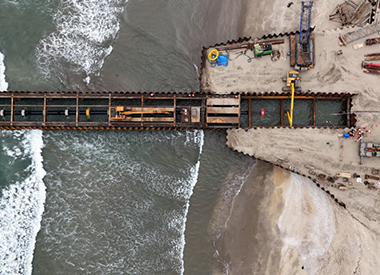
Working within the value chain, we conducted an upstream assessment of mining tyres and a downstream initiative at Saldanha Bay using environmental DNA (eDNA)*.
Upstream: understanding and influencing supply chain impacts
Mining tyres are a critical input to operations, yet their production depends heavily on natural rubber, a commodity associated with deforestation, biodiversity loss, and social impacts in tropical landscapes.
To better understand these risks, we undertook a detailed pilot assessment of the tyre supply chain, focusing on natural rubber sourcing linked to Michelin.
This work was undertaken as part of a Taskforce on Nature-related Financial Disclosures (TNFD) pilot and followed the LEAP process (Locate, Evaluate, Assess, Prepare), providing a structured and repeatable way to assess nature-related dependencies and impacts in complex supply chains.
Using global datasets and tools such as the WWF Biodiversity Risk Filter, ENCORE, IBAT and Global Forest Watch, we mapped priority suppliers and identified high-risk sourcing regions, including rubber plantations in Indonesia.
The assessment highlighted dependencies on ecosystem services such as soil fertility and water regulation, alongside significant risks related to deforestation, habitat loss and impacts on threatened species and local livelihoods.
These nature-related risks also translate into business risks, including supply disruption, price volatility, regulatory pressure and reputational exposure.
While the pilot produced specific insights for one priority supplier, its broader value lies in how it demonstrates a proactive, upstream approach.
Rather than treating supply chain impacts as outside its remit, we are using this analysis to engage suppliers, encourage commitments such as zero deforestation and restoration, and explore system-level solutions including alternative materials, recycling and landscape-scale nature-based solutions.
This reflects a deliberate shift from reactive risk management towards shared responsibility and collaboration across the value chain.