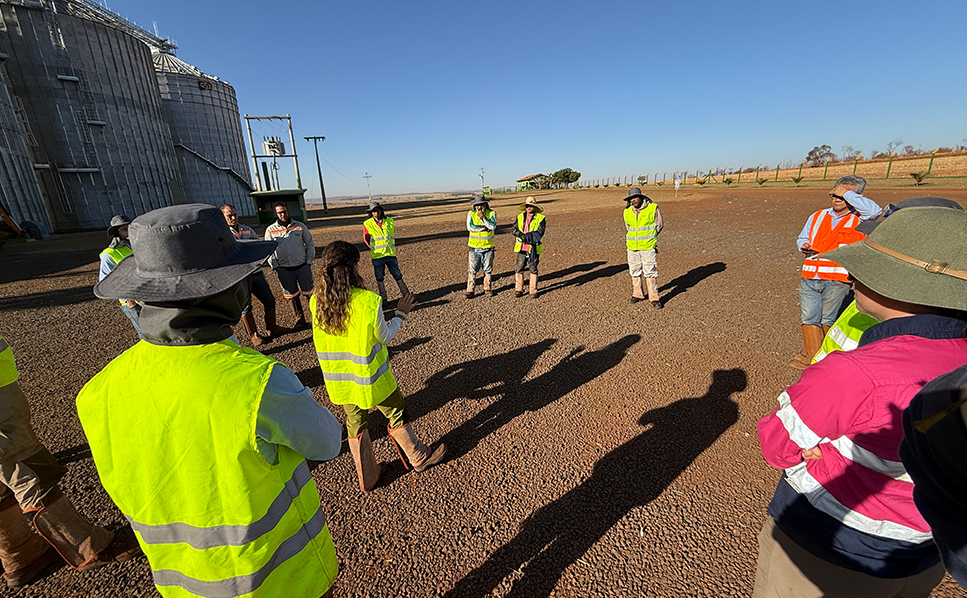
In partnership with ZeroEx and Isometric, we are combining existing infrastructure and operational capacity with cutting-edge technology and industry-leading expertise to create efficient climate solutions using enhanced rock weathering (ERW).
ERW is one of the most impactful, cost-effective and scalable methods of durably removing carbon from the atmosphere. By using a ferronickel slag – a waste product generated during the smelting process – as a feedstock for the ERW process, we are demonstrating how mining by-products can be repurposed for carbon removal while providing co-benefits for agriculture.
Our approach to carbon mitigation is to deliver carbon offsetting with projects developed from our own underutilised assets. ERW perfectly aligns with this approach, turning a mineral waste into a tool to durably remove carbon dioxide (CO2) from the atmosphere.
ERW is a carbon removal approach that aims to speed up weathering. In natural systems, CO2 dissolves in rainwater to form carbonic acid. This acid very slowly reacts with rocks containing magnesium or calcium, gradually weathering them (wearing them away). In this reaction, the magnesium, calcium and CO2 are either stored in very stable solid forms, or transported to the ocean, trapping them for thousands of years. The idea of Enhanced Rock Weathering is to crush the right rocks and incorporate them into soils – this increases the surface area for the reaction, speeding up the weathering process and the trapping of CO2.
Our ERW initiative called Project Earthstone uses magnesium-rich slag from our operations in Brazil. Aside from weathering much faster than natural rocks, it also acts as a mineral fertiliser that benefits farmers while drawing down CO2. The mineral fertiliser improves soil health and crop productivity by providing pH correction as well as magnesium, which is a highly depleted secondary crop nutrient in most Brazilian soils.