Facebook Pixel .
Close
About us
Find out more
Our portfolio
Find out more
Sustainability
Sustainability Strategy
Discover our Sustainability Strategy
Sustainable Mining Plan
FutureSmart Mining™
Find out more
Investors
Find out more
Careers
Find out more
Media
Find out more
Suppliers
Find out more
Origins
Main Content

In addition to our commitment to achieving a Net Positive Impact on biodiversity, we implement Additional Conservation Actions (ACAs)* to address impacts or legacy losses that may not be fully captured within the quantified NPI baseline.

These actions are informed by local context, conservation priorities, and opportunities to deliver broader ecological and societal value beyond what would be understood by the ICMM No Net Loss approach**.

Whilst NPI is voluntary, our ACAs go beyond permitting requirements to include wider initiatives such as conservation grants, native species research programmes, species recovery partnerships and the establishment of botanical gardens.

Through the Anglo American Foundation, we have established Nature Positive Grants to catalyse positive change beyond our operational footprint.

These grants are designed to support nature-based solutions that align with our objectives for biodiversity, water, and climate, while also delivering long-term socio-economic benefits.

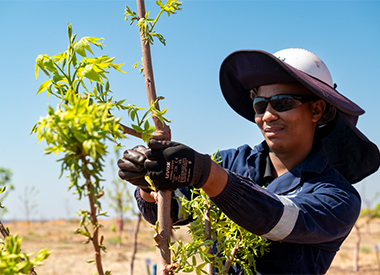
We also support native plant nurseries, educational initiatives and community-based conservation projects that help to strengthen ecological resilience.

In Peru, for example, targeted species programmes are improving population viability and expanding habitat extent.

These ACAs enable us to extend conservation benefits beyond our direct land footprint, enhance ecological connectivity, support local conservation capacity and contribute to both regional and global biodiversity objectives.

Since inception, the programme has committed US$2.5million (up to US$500,000 per funding round), supporting multiple projects across Latin America, southern Africa, Australia and Europe, with work taking place well beyond Anglo American’s operational footprint.

Funded initiatives are selected for their ability to deliver measurable biodiversity outcomes, contribute to national conservation priorities, and generate knowledge and tools that can be used widely by conservation practitioners, governments and communities.

Projects supported to date include restoration of ancient woodlands and river systems in the UK, bringing more than 10 hectares of woodland and kilometres of watercourse under active conservation management, improving habitat for priority species while engaging local communities through citizen science and volunteering.

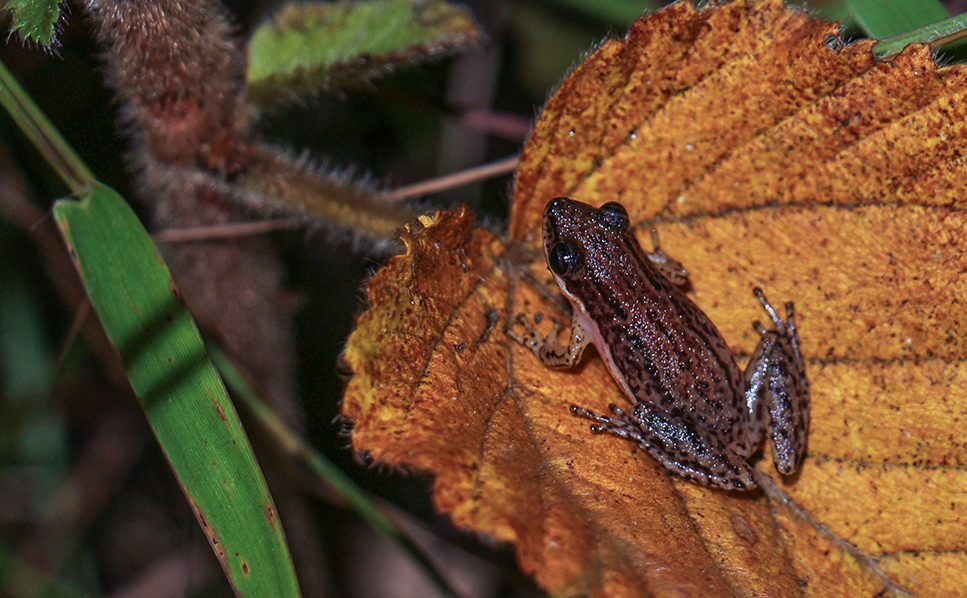
In Brazil, grants have supported flagship species programmes in the Cerrado - the world’s most biodiverse savanna - strengthening protection of endemic and threatened amphibians through regional surveys, education campaigns and data sharing with national and international conservation networks.

In Peru, funding has enabled the first intensive monitoring of the endangered marine otter along the southern coastline, generating critical population, habitat and water-quality data to inform national conservation planning.

Across Australia and southern Africa, grants have advanced innovative national-scale monitoring tools, including acoustic observatories and biodiversity informatics platforms, improving access to threatened species data and supporting better land-use decision-making at country level.

Together, the Nature Positive Grants demonstrate how targeted corporate funding can deliver enduring conservation outcomes at scale, strengthening ecosystems, supporting communities and contributing to nature recovery well beyond individual project sites.

* Additional Conservation Actions are extra steps taken – such as restoring habitats – that go beyond what is legally required, to provide further benefits to nature and ecosystems.

** The ICMM No Net Loss approach means making sure that any negative impacts an organisation has on biodiversity are balanced out by positive actions, so that there is no overall loss of nature.

plc