Anglo American’s Responsible Sourcing Standard for Suppliers is designed to set the expectations that we have for companies who want to partner with us as suppliers.
The Standard was developed in line with our commitments to international best practice under the UN Global Compact, UN Guiding Principles on Business and Human Rights, Voluntary Principles on Security and Human Rights, and under our membership of the International Council on Mining and Metals (ICMM). As such, our Standard covers key aspects with respect to safety, health, environment, business integrity, labour and human rights, and contribution to supporting thriving communities in the regions where we operate.
Anglo American’s partnership with Slave Free Alliance
In 2024 Anglo American commenced a three-year partnership with Slave-Free Alliance (SFA), an international social enterprise supporting organisations to protect their operations, supply chains and people from modern slavery and labour exploitation. SFA was started in 2018 and now partners with over 120 organisations of all sizes and across many sectors in the UK, USA, Norway and Australia, to build their resilience to modern slavery and labour exploitation.
The partnership with SFA has provided us with an opportunity to bring in additional external expertise to assess our approach to identifying, managing and mitigating potential impacts to labour and human rights in our supply chains. Having a partner such as the SFA provides an opportunity for critical review of our Standard and its implementation, as well as constructive support in how to improve.
The partnership involves two stages. Firstly, the review of our current approach and development of recommendations, and secondly, the prioritisation of focus areas to support implementation of mitigation measures and capacity building of teams.
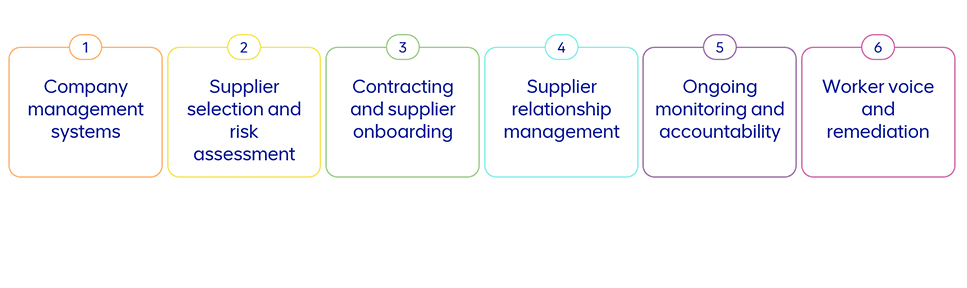
The first stage was completed in Q3 2025. This involved document review of our external and internal policies, standards and guidelines, as well as more than 70 interviews with internal stakeholders. This stage was structured to considering six key areas: